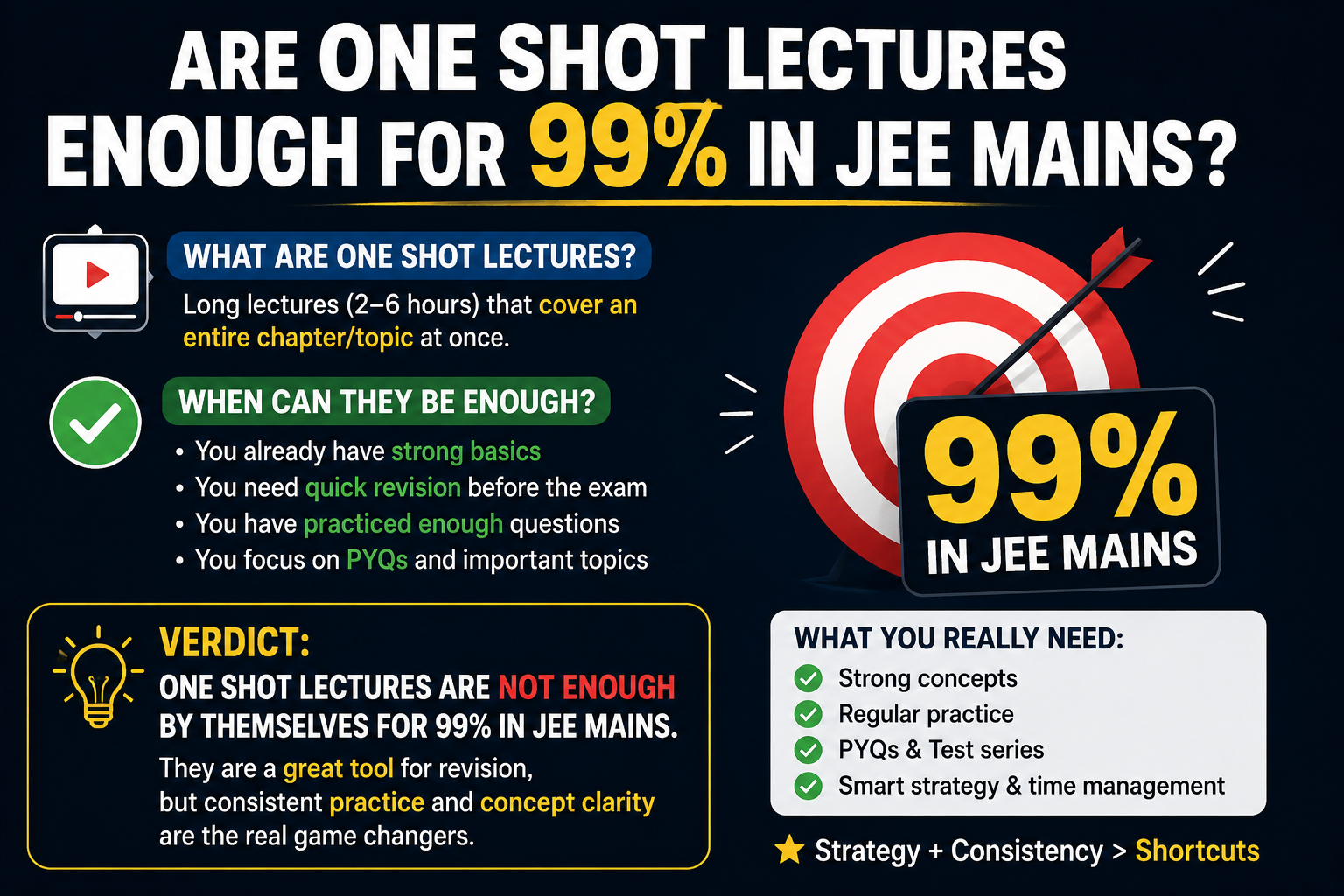
"I have created a backlog in Organic Chemistry. Should I watch Om Pandey sir's one shot lectures for chapter completion? Are they enough to score 99 percentile in JEE Mains?"
Organic Chemistry Backlog: Are One Shot Lectures Enough for 99 Percentile in JEE Mains?
Every aspirant with a backlog secretly hopes that one 3 hour video can replace a month of pending work. So this doubt deserves a straight, honest answer: can one shot lectures for JEE Mains, including Om Pandey sir's famous organic one shots, actually carry you to 99 percentile?
Here is the answer, the data behind it, and the exact way to use one shots so they help your preparation instead of quietly damaging it.
No. One shot lectures are not enough for 99 percentile. For 99 percentile, full length detailed lectures are compulsory, and you must read NCERT thoroughly. One shots are a revision tool. They were never designed to replace your first round of learning.
That is the whole post in three lines and three numbers. The rest of this guide shows why it is true, compares the teachers students keep asking about, and gives you a complete plan, with charts and a ready timetable, to actually clear the organic chemistry backlog.
What a One Shot Lecture Actually Is (and What It Is Not)
A one shot compresses 12 to 20 hours of classroom teaching into 2 to 4 hours. To manage that, the teacher has to cut something, and what gets cut is exactly what organic chemistry runs on: mechanism derivations, exceptions, in-between practice questions, and the slow repetition that builds memory. What survives is a high speed map of the chapter.
A map is genuinely useful, but only if the territory already exists in your head. If you have studied the chapter before, a one shot refreshes it brilliantly. If you have never studied it, you are watching a summary of knowledge you do not have.
✅ One shots work well when
- You already studied the chapter once and need fast revision
- You want a quick chapter map before starting PYQs
- The chapter is low weightage and time is critically short
- You are in the final revision weeks before the exam
❌ One shots fail when
- It is your first time learning the chapter
- The chapter is mechanism heavy: GOC, carbonyl compounds, named reactions
- You need to retain reactions for months, not days
- Your target is 99 percentile, where application questions dominate
One Shot vs Detailed Lectures: What Each Actually Delivers
Concept depth
Retention after a month
Problem solving coverage
Speed (time saved)
Illustrative scores to show the trade-off: a one shot wins only on speed, and 99 percentile is not a speed contest.
Why 99 Percentile Demands Detailed Lectures
At 99 percentile there is almost no room to drop chemistry marks, and organic chemistry is too big a slice of the paper to bluff through. JEE Mains organic questions are rarely "identify the definition" questions. They are conversions, reagent based questions, mechanism logic, and reactions lifted straight from NCERT.
Here is the trap with one shots. When the teacher writes a reaction on screen, you nod, because you recognise it. But in the exam hall there is no teacher and no screen, only a blank rough sheet and a four step conversion. Recognition feels like knowledge while you watch; recall is what the paper actually tests. The graph below shows the typical pattern.
The Forgetting Curve: One Shot Only vs Detailed Study + Revision
Illustrative retention pattern based on how forgetting typically works. Exact numbers vary by student, the gap does not.
Where Organic Questions Come From: Chapter Weightage
Before you decide what deserves a detailed lecture and what can survive on a one shot, look at where organic marks actually sit. The split below shows the approximate share of organic chemistry questions by chapter group, based on PYQ trends.
Approximate Share of Organic Questions in JEE Mains (by chapter group)
Indicative split based on recent PYQ trends. Exact weightage shifts from session to session, the top three groups rarely do.
Read the chart like this: the top four bars carry roughly 60 percent of your organic marks. Those are the chapters where one shots are most dangerous as a primary source, and where detailed lectures plus NCERT pay back every minute you invest.
Om Pandey Sir vs RA Sir vs M.S Chouhan Sir vs N.S Sir
Students keep mixing up these four names while hunting for chemistry lectures, so let us be precise about what each teacher is actually known for. The honest catch first: two of these four do not even teach organic chemistry as their core subject.
| Teacher | Platform | Subject Focus | Teaching Style | Best Used For |
|---|---|---|---|---|
| Om Pandey Sir | PhysicsWallah (JEE Wallah) | Organic Chemistry | Fast, engaging one shots and revision sessions with strong PYQ focus | Revision and backlog mapping after your first round of study |
| Rohit Agarwal Sir | PhysicsWallah (JEE Wallah) | Organic Chemistry | Patient, detailed concept building from zero, beginner friendly | First time learning and full length chapter coverage |
| M.S. Chouhan Sir | Vibrant Academy, Kota | Organic Chemistry | Question rich, NCERT linked organic teaching | Organic backlog and practice, not organic |
| Neeraj Saini Sir | Competishun | Organic Chemistry | Structured, concept first lectures | Comprehensive, deep, and unrestricted classroom-level content |
Om Pandey Sir
PhysicsWallah (JEE Wallah) OrganicHugely popular among PW students for high energy organic one shots and revision lectures that point directly at what JEE actually asks. Excellent at compressing a chapter. But a compressed map cannot replace your first detailed study round: use his one shots after studying a chapter, not instead of studying it.
Rohit Agarwal Sir
PhysicsWallah (JEE Wallah) OrganicBuilds Organic Chemistry from absolute basics with exceptional depth and clarity. If your backlog means you never properly understood GOC, isomerism, reaction mechanisms, or fundamental organic concepts, RA Sir’s full-length lectures are a much better choice than any one-shot course.
M.S Chouhan Sir
Vibrant Academy, Kota InorganicMS Chauhan Sir is one of the most respected Organic Chemistry educators in India . If your backlog lies in Organic Chemistry especially topics like GOC, reaction mechanisms, hydrocarbons, and advanced problem solving his lectures and books can be an excellent remedy. .
Neeraj Saini Sir
Competishun organicNS Sir is known for his highly structured, concept-first approach that emphasizes deep understanding of reaction mechanisms and logical problem-solving. If your backlog is in Organic Chemistry whether it's GOC, isomerism, reaction mechanisms, or named reactions—his full-length lectures are among the best resources to rebuild your foundation. .
The 6 Step Plan to Clear an Organic Chemistry Backlog
Audit the backlog
List every pending chapter and tag it High, Medium, or Low using the weightage chart above. GOC, carbonyl compounds, haloalkanes plus alcohols, and amines almost always land in High.
Detailed lectures for every High chapter
Watch full length lectures at 1.25x to 1.5x speed, pause to write each reaction yourself, and make short notes. Speed should come from playback, never from skipping depth.
One shots only where they belong
Use one shots for Low weightage chapters, as a 20 minute preview before a detailed lecture, or as a revision pass after it. Never as the only exposure to a High weightage chapter.
Read NCERT line by line
Cover the intext examples, the back exercises, and every named reaction box. JEE Mains repeatedly picks reactions straight out of the NCERT organic chapters.
Solve PYQs the same day
Finish a chapter, then solve its previous year questions the same day while the reactions are fresh. This is the exact step that converts recognition into recall.
Maintain a reaction register
Keep one notebook of reagents, conversions, and mechanisms, and revise it weekly. Backlogs return the moment revision stops.
How to Split Your Weekly Backlog Hours
Suppose you can give organic chemistry around 15 hours a week on top of your regular schedule. Here is the split that keeps the focus on learning first and lets one shots play only their supporting role.
Recommended Weekly Time Split for Backlog Recovery
- Detailed lectures + own notes40% · 6 hrs
- PYQs + problem solving25% · ~4 hrs
- NCERT reading + exercises20% · 3 hrs
- Weekly revision + one shots15% · ~2 hrs
Notice where one shots sit: inside the smallest slice, as part of revision. That is their honest share.
Sample One Week Backlog Recovery Timetable
Here is what one week of that split looks like in practice, assuming GOC is your first High weightage pending chapter. Repeat the same pattern with the next chapter every week.
| Day | Focus | Task | Time |
|---|---|---|---|
| Monday | GOC | Detailed lecture part 1 + handwritten short notes | 2.5 hrs |
| Tuesday | GOC | Detailed lecture part 2 + NCERT intext questions | 2.5 hrs |
| Wednesday | GOC | Chapter wise PYQs + error list | 2 hrs |
| Thursday | GOC | Remaining lecture portion + NCERT back exercises | 2.5 hrs |
| Friday | GOC | Mixed PYQs + revise the error list | 2 hrs |
| Saturday | Low weightage chapter | One shot + NCERT skim + 15 PYQs | 2 hrs |
| Sunday | Full week | Reaction register revision + 30 minute mini test | 1.5 hrs |
Runs alongside your regular class or self study schedule. Shrink the hours if needed, but keep the ratio between the four activities.
Why "Read NCERT Thoroughly" Is Non Negotiable
A large share of organic chemistry questions in JEE Mains map directly to NCERT lines, reactions, and named reactions. Toppers treat the NCERT organic chapters like a question bank: every reaction is a potential conversion question, and every exception is a potential assertion reason question.
- Read each organic chapter at least twice, cover to cover
- Attempt every intext and back exercise question before seeing the solution
- Turn every named reaction box into a flashcard
- Mark exceptions and "note that" lines; they become assertion reason questions
- Revise the marked lines in your weekly revision slot
If a one shot is your map and detailed lectures are your training, NCERT is the ground you will actually be tested on.
FAQ: One Shots, Backlogs and 99 Percentile
Are one shot lectures enough for 99 percentile in JEE Mains?
No. One shot lectures are a revision tool, not a learning tool. For 99 percentile you need full length detailed lectures, thorough NCERT reading, and chapter wise PYQ practice. Use one shots only to revise chapters you have already studied properly.
Can I clear my organic chemistry backlog only with one shot lectures?
Only for low weightage chapters. High weightage chapters like GOC, carbonyl compounds, and amines need detailed lectures, your own notes, and same day PYQ solving. A one shot can map a chapter, but it cannot build the recall that exam questions demand.
One shot vs detailed lectures: which is better for organic chemistry?
They do different jobs. Detailed lectures are for first time learning and depth, while one shots are for revision and quick chapter maps. The right sequence is detailed lecture first, NCERT and PYQs next, one shot later as revision.
Is NCERT enough for organic chemistry in JEE Mains?
NCERT is the compulsory base, and many JEE Mains organic questions come directly from it. For a 99 percentile target, pair a thorough NCERT reading with chapter wise PYQs and one good problem source for extra practice.
This Entire Post Started as One Student's Doubt
Stuck with a backlog, strategy, or college doubt of your own? Drop it in the doubt box and we will turn it into a complete, honest guide like this one.
Submit Your Doubt 🚀Charts marked illustrative or indicative are visual guides, not official statistics. Teacher observations are based on publicly available lectures and general student feedback; sample a lecture before committing to any source.