Dropper Year Strategy for JEE/NEET 2027: Complete Month-by-Month Plan
A smart dropper year strategy can completely change your JEE or NEET result. Most students fail not because they work less, but because they repeat the same mistakes. This guide explains a realistic JEE NEET dropper plan, including a monthly strategy, study timetable, revision cycle, and the biggest mistakes droppers make.
Should You Take a Drop for JEE or NEET?
Before following any dropper year strategy, ask yourself honestly why your previous attempt did not go well.
- Weak concepts or fundamentals
- Late preparation start
- Poor revision strategy
- Lack of mock test practice
- Bad time management
If these problems are fixable, then a drop year can absolutely work.
5 Golden Rules of a Successful Dropper Year
- Analyse your previous mistakes. Your entire strategy should fix those exact issues.
- NCERT is mandatory. Especially for NEET Biology and JEE Chemistry.
- Start mock tests early. A dropper year is won through testing and analysis.
- Use limited resources. Finish fewer books completely instead of collecting many.
- Track weekly progress. Consistency matters more than motivation.
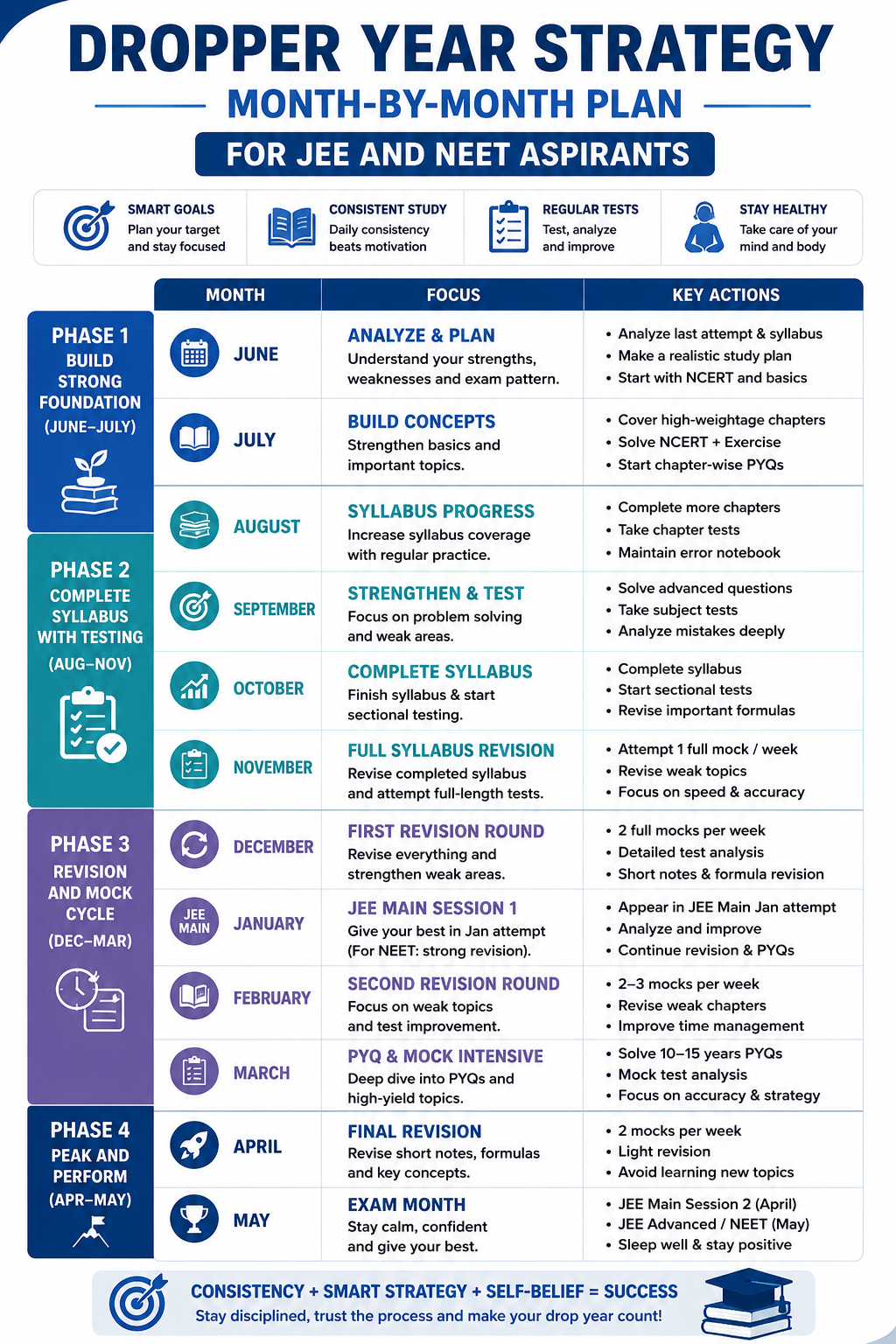
Month-by-Month Dropper Year Strategy
Phase 1 — Foundation Building (June–July)
This is the most important phase of your dropper month-by-month timetable.
- Identify weak chapters
- Rebuild concepts using NCERT
- Start chapter-wise PYQs
- Create a fixed daily routine
Goal: Complete 25–30% syllabus with strong basics.
Phase 2 — Syllabus Completion (August–November)
- Complete remaining syllabus
- Give chapter-wise tests regularly
- Maintain an error notebook
- Start part syllabus mocks
Goal: Finish entire syllabus before December.
Phase 3 — Revision & Mock Test Cycle (December)
- Focus mainly on revision
- Give 2–3 mocks weekly
- Analyse every test deeply
- Revise weak topics repeatedly
Goal: Improve accuracy, speed, and confidence.
Phase 4 — Peak Performance Phase (January)
- Revise formulas and short notes
- Avoid unnecessary new topics
- Fix sleep schedule
- Stay mentally calm
Goal: Peak exactly during the exam period.
Best Daily Timetable for Droppers
One of the biggest myths about a dropper year strategy is that students must study 16 hours daily.
In reality, 8–10 focused hours are enough.
- Morning: Hardest subject
- Afternoon: Practice + second subject
- Evening: Third subject or mock test
- Night: Revision + error notebook
Common Dropper Year Mistakes
- Restarting everything from zero
- Ignoring mock tests
- Using too many resources
- Comparing yourself with toppers
- Ignoring sleep and health
Subject-Wise Strategy for JEE & NEET Droppers
Physics Strategy
Focus on concept clarity and regular problem solving. Mechanics and Electrodynamics are high-weightage chapters.
Chemistry Strategy
NCERT is extremely important for Inorganic Chemistry. Organic needs mechanism understanding while Physical Chemistry improves through daily numericals.
Maths Strategy
Calculus and Algebra provide maximum marks potential in JEE. Speed improves only through massive question practice.
Biology Strategy
NEET Biology should be revised line-by-line from NCERT. Biology is the scoring engine of NEET preparation.
How to Stay Mentally Strong During a Drop Year
The biggest challenge in a dropper year strategy is mental consistency.
Every dropper faces self-doubt, low-confidence phases, and burnout moments. Successful students are not the ones who never struggle they are the ones who continue consistently.
Frequently Asked Questions
Is a dropper year worth it for JEE or NEET?
Yes, if your previous attempt failed due to fixable mistakes like weak concepts, poor revision, or lack of testing.
How many hours should droppers study daily?
8–10 focused hours are more effective than fake 14–16 hour schedules.
Should droppers join coaching?
Coaching helps with structure, but disciplined self-study with proper mock tests can also work very well.
When should droppers start preparation?
Ideally from June immediately after results to get enough time for revision and mocks.
Final Thoughts on Dropper Year Strategy
A successful dropper year strategy is not about studying harder — it is about studying smarter than your previous attempt.
Stay consistent, revise properly, analyse mocks honestly, and trust the process.
Best Drop Year Coaching
Our honest recommendations by exam category for JEE and NEET aspirants.
Physics Wallah
Affordable, structured learning for JEE aspirants.
Competishun
Deep concept clarity with strong Advanced preparation.
Motion
Practice-focused batches and structured mentorship.
Vibrant
Strong mentoring and Kota-style preparation system.
Unacademy
Wide variety of educators and live classes.
Allen Online
Excellent test series and strong faculty ecosystem.
Allen Kota
Top Kota ecosystem and consistent JEE results.
Motion
Excellent classroom practice and doubt support.
Resonance
Advanced-level preparation with strong modules.
Vibrant
Personal mentoring and focused classroom batches.
PW Vidyapeeth
Affordable offline coaching with modern classrooms.
PW NEET
Budget-friendly NEET preparation with good teachers.
Motion
Structured mentoring and disciplined study plans.
E-Saral
Concept-based teaching with online-focused learning.
Aakash
Strong NEET track record and nationwide centers.
Allen
Top NEET batches with excellent test practice.